
EMPIRE OF FAE · FULL SPOILERS
FAE EMPIRE
A Traveller’s Guide to Fairyland.
Open each section to explore the complete geography, politics, peoples, cities and customs recorded in Louisa Webb’s world guide.
← Return to Political Realms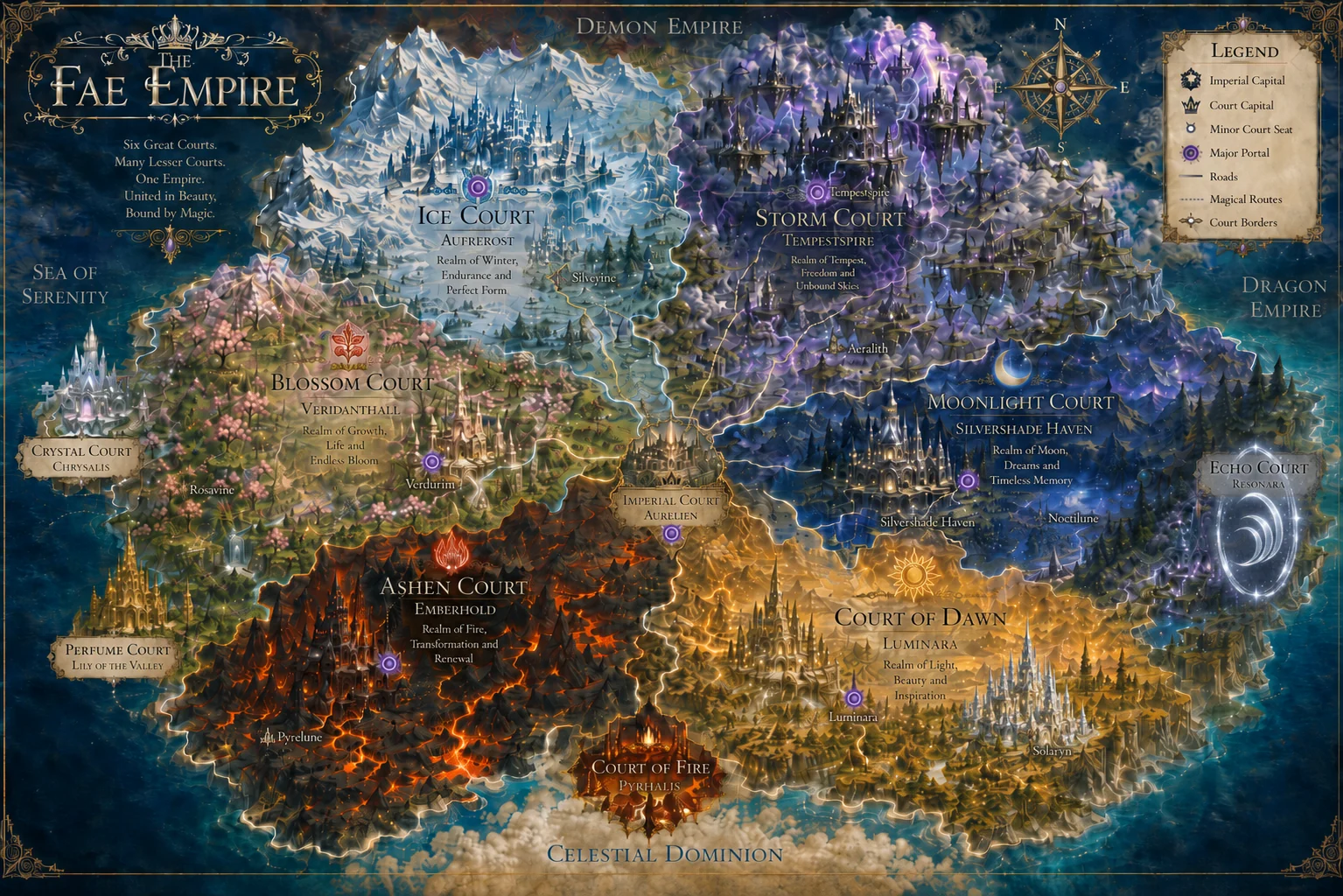
General Geography
The Fae Empire is less a single uniform country than a federation of magical Courts gathered beneath one imperial crown. Geography, politics and magic are unusually intertwined: crossing from one Court into another can mean passing from frozen mountains into perpetual blossom, from volcanic woodland into eternal twilight, or from ordinary ground onto islands suspended inside a living storm. Court identity shapes the land itself as much as architecture, fashion and culture.
It is situated south of the Demon Empire, west of the Dragon Empire and north of the Celestial Dominion.
There are six Major Courts, each possessing a territorial province of its own:
Ice Court
Moonlight Court
Blossom Court
Ashen Court
Court of Dawn
Storm Court
Alongside them exist numerous Minor Courts, including the Musical Court, Crystal Court, Court of Echoes, Perfume Court and Moonlit Court. Minor Courts do not possess provinces of their own and are generally governed by nobles whose titles range from Lords and Ladies to more influential noble ranks. They commonly establish political relationships with one of the Major Courts or another powerful patron. Please note the Moonlit Court is situated in Thragund, a village in Roseheart Forest in the Demon Empire.
The result is an Empire in which travelling a few hundred miles can feel considerably more dramatic than crossing an international border.
Government and the Six Major Courts
The Fae are politically plural. Each Major Court has its own King and/or Queen, government, traditions, laws, magical specialisations and political interests. The Emperor stands above the Courts in matters affecting the Empire as a whole, but does not replace their individual monarchs or governments. The manuscript repeatedly treats the Courts as separate political actors capable of alliances, rivalries and independent pledges.
The imperial crown is not hereditary. A ruler does not become Emperor merely because their parent held the title. A candidate needs the favour of at least half of the six Major Courts before taking the imperial throne.
Aurelian Frostfey inherited the Ice Court throne immediately upon the death of his parents and subsequently became Emperor after receiving the support of the Ice, Ashen and Storm Courts. The Dawn Court opposed him, while Moonlight and Blossom remained neutral because of his involvement in the Year of the Fractured Light.
The practical structure is therefore roughly:
Emperor or Empress of the Fae
→ Six Major Courts, ruled by Kings and Queens
→ Noble Houses and estates within their provinces
→ Minor Courts, usually governed by titled nobles and politically aligned with stronger powers
Court politics are conducted as much through introductions, hospitality, balls, invitations, favours, ceremonial acknowledgements and public pledges as through formal legislation.
The Six Major Courts
The Ashen Court
The Ashen Court is the Fae Court of fire, transformation, destruction and renewal, ruled by King Korrad Cinderflare from Emberhall. Its province is shaped by charred forests, lava and ash, while its culture treats destruction as part of the cycle of change.
Best known for: fire magic, metallurgy, volcanic landscapes and dramatic solutions.
The Blossom Court
The Blossom Court is the Fae Court of life, growth, healing, renewal and natural cycles, ruled by Queen Avelina Petalbright from Verdanthall. Its lands are famous for ever-blooming meadows, ancient trees and cultivated magical flora.
Best known for: healing, gardens, botanical magic and living resources.
The Court of Dawn
The Court of Dawn is the Fae Court of beauty, art, invention, renewal, illusion and enchantment, ruled by King Solar from Luminara. It is one of the Empire's great cultural centres and is as famous for magical experimentation as for the occasional disaster that follows it.
Best known for: art, illusion, invention, living architecture and enchantment.
The Ice Court
The Ice Court is the Fae Court of ice, winter, precision, restraint and endurance, ruled by King Aurelian Frostfey from Aurefrost. Its realm is defined by glaciers, crystalline architecture and highly controlled magic, and it is the Court of the current Fae Emperor.
Best known for: winter magic, glacial architecture, crystalline craftsmanship and royal ceremony.
The Moonlight Court
The Moonlight Court is the Fae Court of moonlight, reflection, memory, dreams, stillness and secrecy, ruled by Queen Aine from Silvershade Haven. Its province lies beneath eternal twilight and places exceptional cultural importance on memory, continuity and preservation.
Best known for: lunar magic, dreams, memory, divination and night architecture.
The Storm Court
The Storm Court is the Fae Court of tempest, freedom, wind, rain and raw elemental power, ruled by King Tempestus Galeheart and Queen Tempra Varasyn from Tempestspire. Its province consists of floating islands among permanent thunderclouds, and its culture strongly values freedom and movement.
Best known for: storms, lightning magic, floating islands and spectacular travel conditions.
Minor Courts
Minor Courts are genuine political and cultural entities, but unlike the six Major Courts they do not possess provinces of their own.
They are commonly governed by nobles rather than Kings or Queens, with titles varying according to the Court's size, age, prestige and political influence. A minor Court may be headed by a Lord or Lady, while a particularly important one might be governed by a Count, Marquess or Duke.
Many minor Courts pledge themselves to a stronger Court, House or other political patron. Others have adopted less conventional arrangements.
The Crystal Court
The Crystal Court is another established Minor Court, defined by order, precision and clarity.
Its principal seat is described as a radiant palace carved into a colossal crystal mountain, where refracted light fills the surroundings with shifting rainbows. Its magical traditions focus on crystal and light manipulation, while its culture values discipline, structure, craftsmanship and perfection.
Unlike the freer Storm and Musical Courts, Crystal culture favours predictability and carefully ordered systems, which helps explain its recurring friction with both.
Best known for: crystal magic, precision craft, architecture and things being exactly where someone decided they belong.
Capital: Chrysalis
Court of Echoes
Fae of resonance, memory, and repetition.
They rule sound that is not music, voices that are not speech, and reflections that are not visual—keeping them separate from the Musical Court and Crystal Court.
Their province might include:
Reverberation caverns
Spoken promises that linger
Echo‑spirits that mimic truths or lies
Ruler: A Resonant Monarch or Queen of Returning Words.
Capital: Resonara
A cavernous, crystalline metropolis where every word lingers and every step sings.
Echo magic governs repetition, memory, and reverberation—distinct from the Musical Court’s intentional sound.
The Moonlit Court
The Moonlit Court is a small Scion Court historically connected to the Moonlight Court but possessing a distinct identity of its own.
Its members include Noctyralyn and her extended family, and the Court numbers only a little over a hundred people when its households and entourages are counted.
It ultimately places itself under the protection of House Roseheart, rather than functioning as an independent territorial power. At Aine's coronation, the Moonlight Queen specifically acknowledges the Moonlit Court as her Court's Scion Court.
It is located in Thragund, a village in Roseheart Forest in the Demon Empire.
Best known for: poisons, Moonlit magic and its close relationship with House Roseheart.
The Musical Court
The Musical Court has deliberately avoided settling permanently under any single Major Court.
Instead, it follows a largely itinerant lifestyle, moving from one Major Court to another rather than remaining in one province for long periods. The Musical Court maintains estates in all six Major Courts, giving its members permanent homes and bases throughout the Empire without requiring a province of their own.
This makes it unusually well connected. Musical Court families can move between very different political circles and often have personal relationships extending throughout the entire Fae Empire.
The manuscript establishes Lord Perran as a Musical Court noble and shows members of the Court moving freely between other Fae territories.
Best known for: music, performance, travel and connections spanning all six Major Courts.
Traveller's advice: Asking where the Musical Court is based is likely to produce the answer, “At the moment?”
Perfume Court
Fae of fragrance, allure, and emotional influence.
They govern scent‑magic, memory tied to aroma, and the ephemeral beauty of blooming air.
Distinct from Blossom because they rule what flowers release, not the flowers themselves.
Distinct from Thorn because they wield seduction, never defense.
Province themes:
Enchanted perfumes
Aromatic illusions
Emotional resonance carried on scent
Ruler: Queen of a Thousand Scents or The Incense King.
Capital: Lily of the Vale
The Imperial Court
The Fae Emperor, currently Emperor Aurelian does not erase the sovereignty of the six Major Courts. Imperial government instead exists above and between them, dealing with matters affecting the Fae collectively, including inter-Court disputes, foreign policy, war, treaties and Empire-wide law.
An Imperial Palace exists and contains imperial administrative and secure areas, including prisons, but its precise geographic relationship to the Court provinces has not yet been fully established in the manuscript. Aurelian specifically sends prisoners to be held beneath the Imperial Palace, confirming that it is distinct enough to function as an imperial institution rather than simply another wing of a Court residence.
The Emperor's political power is therefore partly constitutional and partly personal. A ruler who loses the confidence of the Major Courts cannot treat them merely as subordinate provinces.
Court Relations
Fae politics are rarely divided into simple permanent alliances. Relationships shift according to history, personalities and individual disputes.
Some important established relationships include:
Ice and Ashen: strong political cooperation, particularly under Aurelian and Korrad/Ashara.
Dawn and Blossom: culturally close and economically complementary. Dawn receives pigments and living materials, while Blossom gains access to Dawn creativity and invention.
Dawn and Moonlight: historically transactional. Moonlight has supplied rare dreams and memories for Dawn enchantments, even while the two Courts frequently find one another culturally irritating.
Ashen and Blossom: both value renewal, but their methods differ dramatically.
Storm and Musical: traditionally friendly, reflecting a shared love of movement and freedom.
Storm and Crystal: frequent philosophical friction between spontaneity and order.
This makes the Fae Empire politically fluid. Two Courts may be allies on one issue, economic competitors on another and mutually offended over a ball invitation by the end of the week.
Travel and Permanent Portals
Travel between the Courts has traditionally depended upon roads, flight, Court-specific magical routes, but Franziska's permanent portal network begins transforming Fae transportation.
Known permanent portal destinations include:
Imperial Court palace
Capiitals of the six Major Courts
What to Expect When Travelling Between Courts
The most important rule for travellers is simple:
Do not assume that etiquette learned in one Court will work in another.
A restrained Ice Court introduction, an extravagant Dawn compliment and an Ashen declaration of friendship can communicate very different things.
Fae hospitality is political. An invitation, formal introduction, gift, escort or public welcome can determine whether a foreign visitor is treated as a guest, petitioner, ally or nuisance. Aurelian specifically warns Franzi that entering Dawn as an unknown foreign monarch would leave her trapped in layers of courtesy, while arriving with the introduction of someone Dawn respected would open the Court to her.
Beauty should also not be mistaken for harmlessness. In the Fae Empire, enchantment can be literal, architecture can contain active magic and landscapes may behave according to the magical principles of their Court.
History
The First Courts
Fae legend says the Empire began with two siblings chosen by the Gods: a female Ice Fae, founder of the Winter Court, and her brother, a male Nature Fae, founder of the Summer Court. The Gods granted them the most fertile lands and the siblings divided them fairly between themselves. The oldest stories remember this first age as one of harmony, abundance and joy.
Their children founded Courts of their own, and their descendants founded still more. Later storytellers claim that there were once a thousand Courts, marking this as an age when Fae lands were divided among countless independent rulers, families and magical traditions.
The Unification of the Courts
That fragmented age ended with the ruler remembered simply as the Great Usurper. Through marriage, political absorption and open war, he brought roughly half of the Courts under his authority. He was eventually killed by his own son, who continued the work of unification until only a small number of Minor Courts remained beyond his reach.
His children later reorganised the realm into eight Major Courts. Rather than allowing one bloodline to inherit absolute authority, they established the principle that a new regent required the support of at least half of the Major Courts. Over time the office developed first into kingship and eventually into the imperial system still used today.
Atalya the Great
The first ruler formally acclaimed Empress of the Fae was Atalya the Great. During the Great Drought and the starvation that followed, she is remembered for the miraculous Feeding of the Million, providing food for a million Fae when ordinary harvests had failed. Her elevation transformed the older system of Court-supported kingship into the Fae imperial crown.
Of the original eight Major Courts, two were eventually lost to history. Their names, territories and final fates are no longer reliably preserved, leaving the six Major Courts that govern the Fae Empire today.
Modern History
72 years ago: Year of the Fractured Light — the last major open clash between the elemental Courts before the Great Accord.
70 years ago: The Crimson War / The Empyrean Conflicts begins, drawing the Fae into the conflict that reshapes the great powers of Fairyland.
50 years ago: The Crimson War ends and the Crimson Accords are signed.
6 years ago: Fae Emperor Caelan Frostfey and Empress Eirlys Frostfey are assassinated; Aurelian succeeds them.
6 months ago: Emperor Aurelian is abducted. The Courts conceal his disappearance from the wider world and continue to recognise him as Emperor.
Major Destinations at a Glance
| Destination | Go there for... |
| Ice Court | Glacial architecture, winter magic, the Frostfey royal court |
| Silvershade Haven | Eternal twilight, lunar magic, moonstone architecture |
| Luminarium of Veils | Ancient observatory, portal travel, moving constellations |
| Blossom Court | Ever-blooming landscapes, gardens, healing and rare magical plants |
| Ashen Court | Volcanic forests, lava rivers, fire magic and transformation |
| Luminara | Art, illusion, fashion, invention and spectacle |
| Palace of Auroralei | Living art, royal Dawn culture and dangerous enchantment |
| Tempestspire | Floating islands, storms, lightning architecture |
| Skybreaker Reach | Storm Court portal travel |
| Crystal Court seat | Crystal architecture, precision craftsmanship and light magic |
| Musical Court estates | Music, performances and whichever Major Court they currently occupy |